
Finney Funeral Services

125 Years
in Business

4 Years with
Yellow Pages


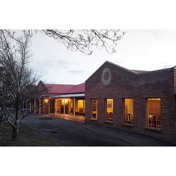

Our aim is to provide a funeral that is in tune with your needs and leaves you with a positive experience.
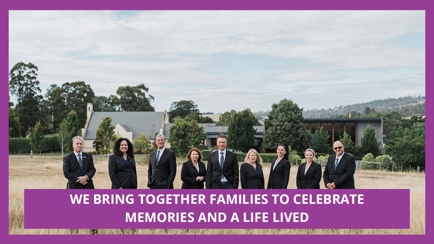
Finney Funeral Services is proudly Tasmanian family owned and operated. We have been providing Tasmanian families with high-quality funeral care and practical advice on arranging funerals for over a century. With our philosophy of trust, care and support at the centre of everything we do, we offer assistance at the time of impending death, up to, and during the funeral.
We've been providing Tasmanian families with high-quality funeral care and practical advice on arranging funerals for over a century, with our philosophy of trust, care and support at the centre of everything we do. Our experienced team help to find the best way of celebrating the life of your loved one. This website is designed to help you through this difficult time. Here you will find clear and precise information on what needs to be done when arranging a funeral, as well as useful advice for coping with grief and bereavement.
In our provision of quality funeral care, we rely upon the support of special people from our community in our funeral directors and support staff. These people are handpicked and equipped to provide a farewell with dignity, purpose, and respect. Over our long history, thousands of Tasmanian families have placed their trust in Finney’s. Finney Funeral Services has consistently been there for our local community to turn to in difficult times. For the families that will use our facilities and expertise, we will provide a positive professional experience, supporting you during a difficult time.
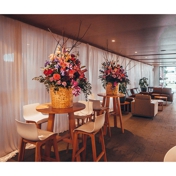
Offering a choice of venues in beautiful locations, Finney’s locations have seating to accommodate any number of guests. All of our venues are fully licensed and have catering options to suit any requirements. When you lose someone, you love, it is very natural to want to have a physical symbol of who they were; a monument to them. Finney Funeral Services' staff have a great deal of experience in memorialisation and can help you decide what sort of remembrance you would like.
What is the difference between a public and a private funeral? What is the difference between a traditional and a lawn type grave?
A public funeral service is announced in the press, and anyone is welcome to attend. A private service is only open to people who are invited by the family. A press announcement is often made after the service. A traditional grave is one that has granite monumental work and kerbing over the top of the grave site. A lawn grave cannot be enclosed with kerbing and is located within a grassed area with a headstone or bronze plaque placed at the head of the grave.
How soon after a cremation are the ashes available?
Ashes are usually available within a day after cremation. However, special arrangements can be made for the ashes to be collected on the same day as the cremation if requested.
During cremation, what happens to the coffin or casket? What happens with jewellery?
At Finney’s, the only thing removed from the coffin or casket prior to a cremation is the nameplate. This stays with the remains to ensure correct identification whilst at the crematorium. The coffin and its hardware are cremated entirely. It is the family’s choice whether jewellery items are removed as a keepsake or left with their loved one.
Is money ‘frozen’ after someone dies?
Bank accounts in joint names should not be affected by the death of one of the owners. Accounts held solely by the deceased may still be able to be accessed, and presentation of a funeral account is often all that is required to release funeral funds to pay for the funeral out of the deceased person’s estate.
Is embalming necessary and who carries this out?
Embalming may be required if the deceased is to be transferred overseas or interstate, placed into an aboveground vault, or if there is going to be a considerable delay before a funeral can be held. Our Funeral Director will advise you of this process if it is needed. Our policy at Finney Funeral Services is to prepare every person irrespective of whether a viewing is being undertaken by the family or not.
How is my loved one cared for whilst in the hands of Finney Funeral Services?
Finney’s staff will treat every person in their care with great respect. They are treated as if the family were present at all times.
When is the Death Certificate issued?
It may take up to three weeks for the Registrar of Births, Deaths, and Marriages to process the information and send the Death Certificate. In some cases, such as coronial inquiries, it can take longer. A certificate is not automatically issued, and your funeral director can apply for this on your behalf. Alternatively, you can apply directly with Service Tasmania. If required, a ‘Priority Certificate’ can be requested from Service Tasmania, which will incur a charge.
What clothing should I provide for my loved one?
The decision of the type of clothing you may like to see your loved one dressed in can be based on a lot of different factors. What did they like to wear? Was there an item that was a favourite? What were they comfortable in? Should I bring underwear and shoes? Our Funeral Directors can guide you with this information. At Finney’s, if the family choose not to provide clothing, we will use an appropriate shroud.
What is the difference between a coffin and a casket?
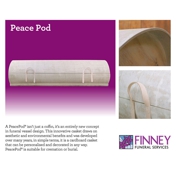
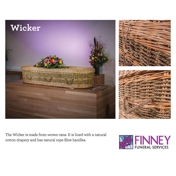
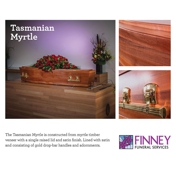
The difference between coffins and caskets is essentially one of design. Coffins are tapered at the head and foot and wide at the shoulders. Caskets are rectangular in shape and are usually constructed of high-quality timbers and feature a high standard of craftsmanship. The decision to select a coffin or casket is made by the family of the deceased according to their personal/financial preferences.
Should young children attend funerals?
There are no set guidelines. Generally, children, in the company of their parents & other family members, are comfortable participating in this family occasion and may even be curious. Use the funeral to help the child learn about the impact of death and the rituals we use to help us respond to bereavement. Children can often contribute creatively to a funeral, perhaps by placing a special flower on the coffin or casket or reading or writing something that can be incorporated into the service.